Products we built, launched and still run.

Most portfolios are screenshots of work handed back to a client. Ours is different: the MCQsLearn ecosystem is designed, engineered, published and operated by Techleens, which means every number on this page can be checked in a browser or an app store right now.

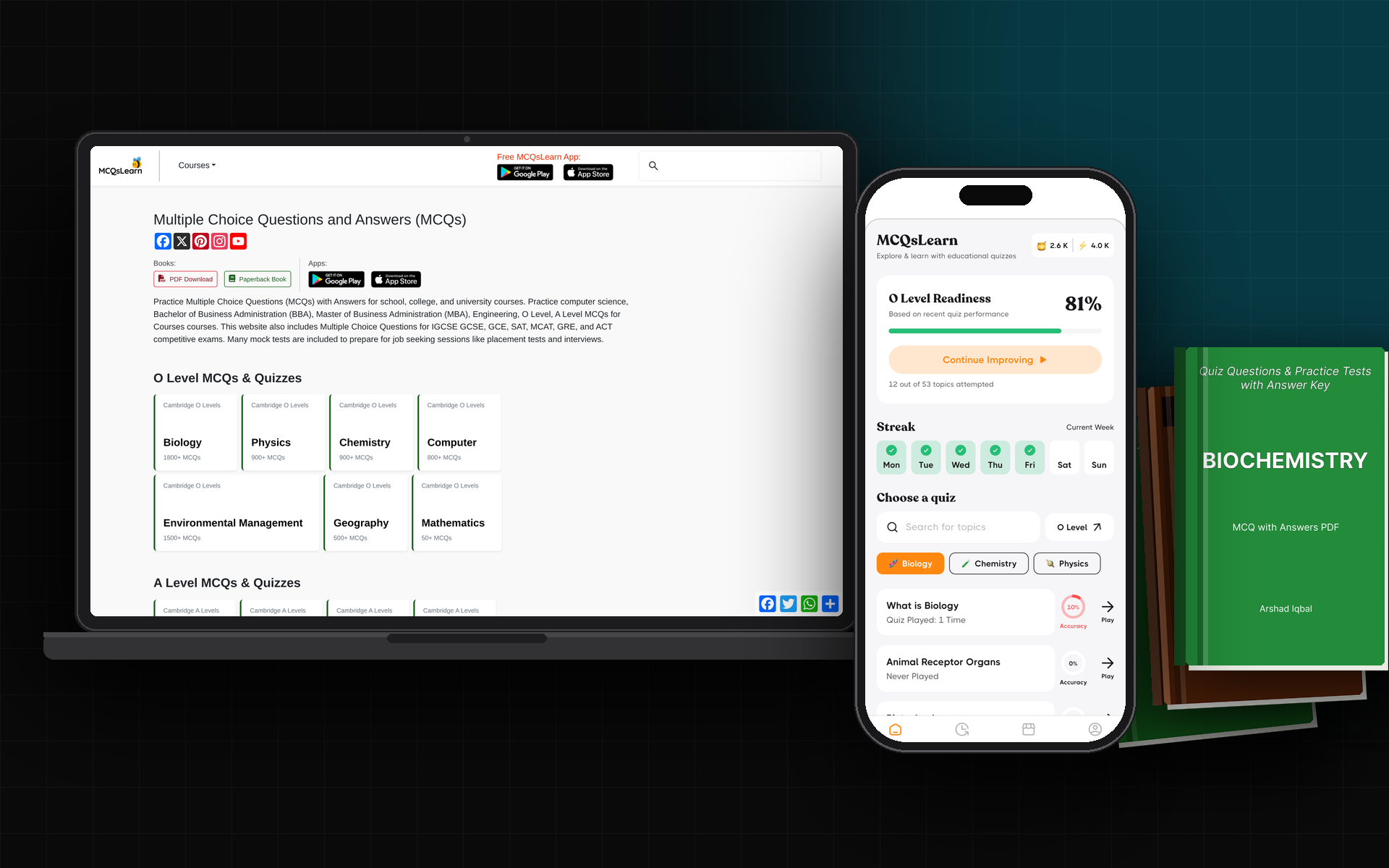
The MCQsLearn ecosystem: MCQsLearn.com on a laptop, the All-in-One Courses app dashboard on an iPhone and three published e-books
0

Questions live across both websites

0

Courses, Class 6 to postgraduate

0

Apps on the App Store & Google Play

0

E-books on Apple Books

4.6★

All-in-One app rating on the App Store

Case study 01 Web PlatformEdTechContent at scaleSEO

MCQsLearn.com & MCQLearn.com

Two exam-preparation websites that serve more than 85,000 practice questions across 110+ courses, from Class 6 science to Cambridge A Levels, SAT, MCAT, BBA/MBA, computer science, engineering and professional certifications.

  • RoleProduct, design, engineering, content ops, SEO
  • PlatformsResponsive web, PWA-ready
  • StatusLive & actively maintained
  • Linksmcqslearn.com · mcqlearn.com
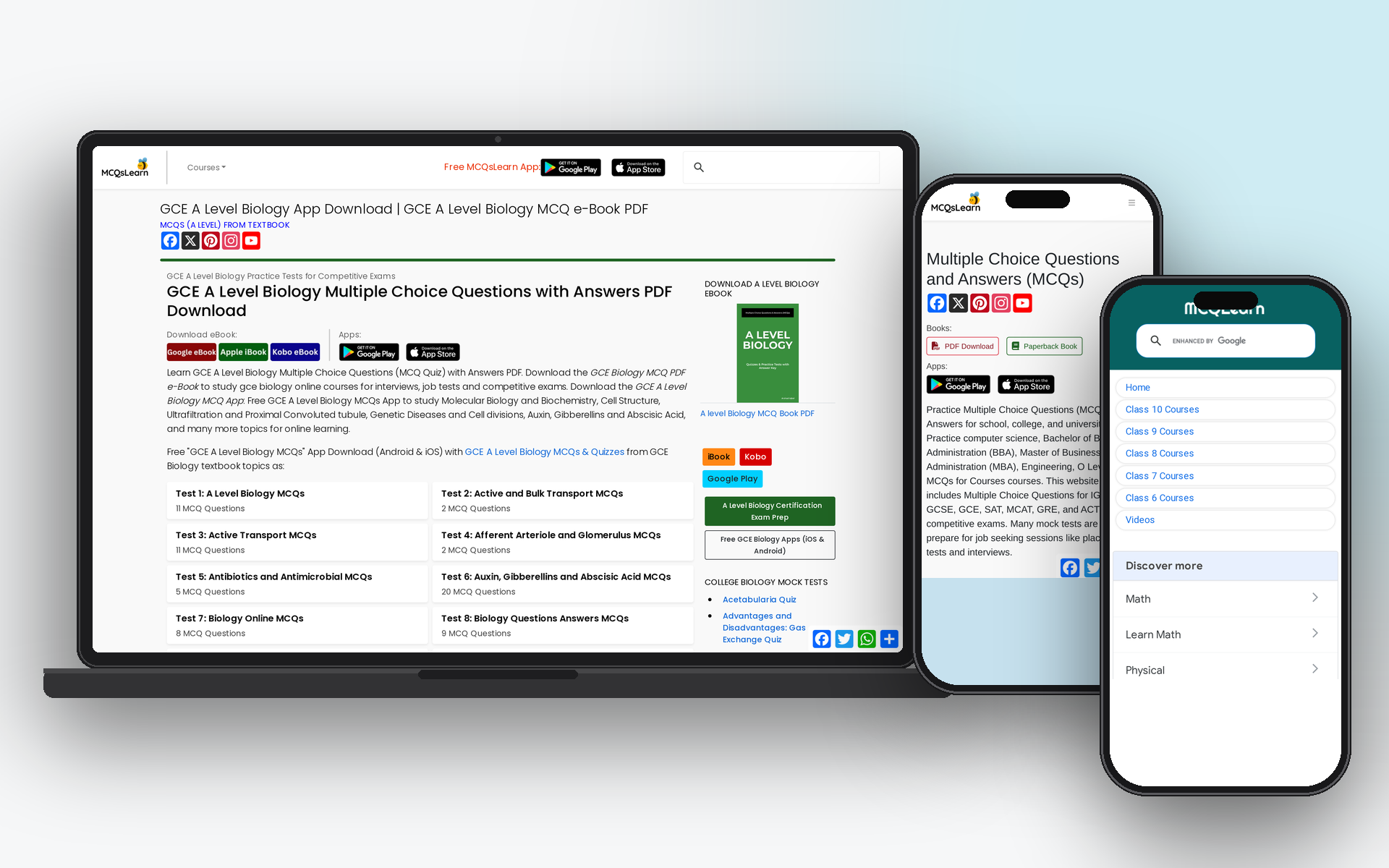
MCQsLearn A Level Biology course page on a laptop beside the MCQsLearn and MCQLearn mobile layouts on two phones
Live pages: the A Level Biology course on desktop, and both platforms' mobile layouts. All screens are real captures, not mock-ups.

The challenge

Students preparing for very different exams (a Class 7 science test, a Cambridge O Level, an MCAT, an MBA course) share one need: large volumes of accurate, topic-organised practice with instant feedback. Serving that need means publishing and maintaining tens of thousands of questions, each tied to a specific board, grade, chapter and topic, and making every one of them discoverable through search.

Doing this with a hand-built CMS breaks quickly. Content becomes inconsistent, pages become slow, and search engines struggle to understand the structure. We needed a system where a single, well-structured content source could drive two differently positioned websites and, later, the apps and e-books.

What we built

Two platforms from one content model. MCQsLearn.com targets secondary, college, university and professional learners; MCQLearn.com is purpose-built for Class 6 to 10 with a simpler, teal, younger-feeling interface. Both are generated from the same question bank, tagged by level → course → chapter → topic, so a correction in one place propagates everywhere.

Structured, crawlable pages at scale. Every course, chapter, topic and quiz has its own semantic URL with clean HTML, descriptive headings and metadata. Cross-links between related topics, e-books and apps are generated automatically. This architecture, not paid acquisition, is how the sites reach students in 150+ countries.

Quiz engine. Topic-wise quizzes with answer explanations, chapter tests and mock tests run client-side for speed, with attempts tracked for returning learners. The same engine logic was later ported to the mobile apps.

Monetisation without hurting learning. Ad placement is kept away from the question area, and every page funnels to the matching PDF e-book, paperback and app download, turning free traffic into product revenue.

Outcome

  • 85,000+ questions live across 110+ courses, maintained by a small content team
  • Class 6 → postgraduate coverage including O/A Level, SAT, MCAT, BBA, MBA, BSCS and engineering
  • Organic-first growth search is the primary acquisition channel for both sites
  • One content source feeding two websites, 55 apps and 98 e-books
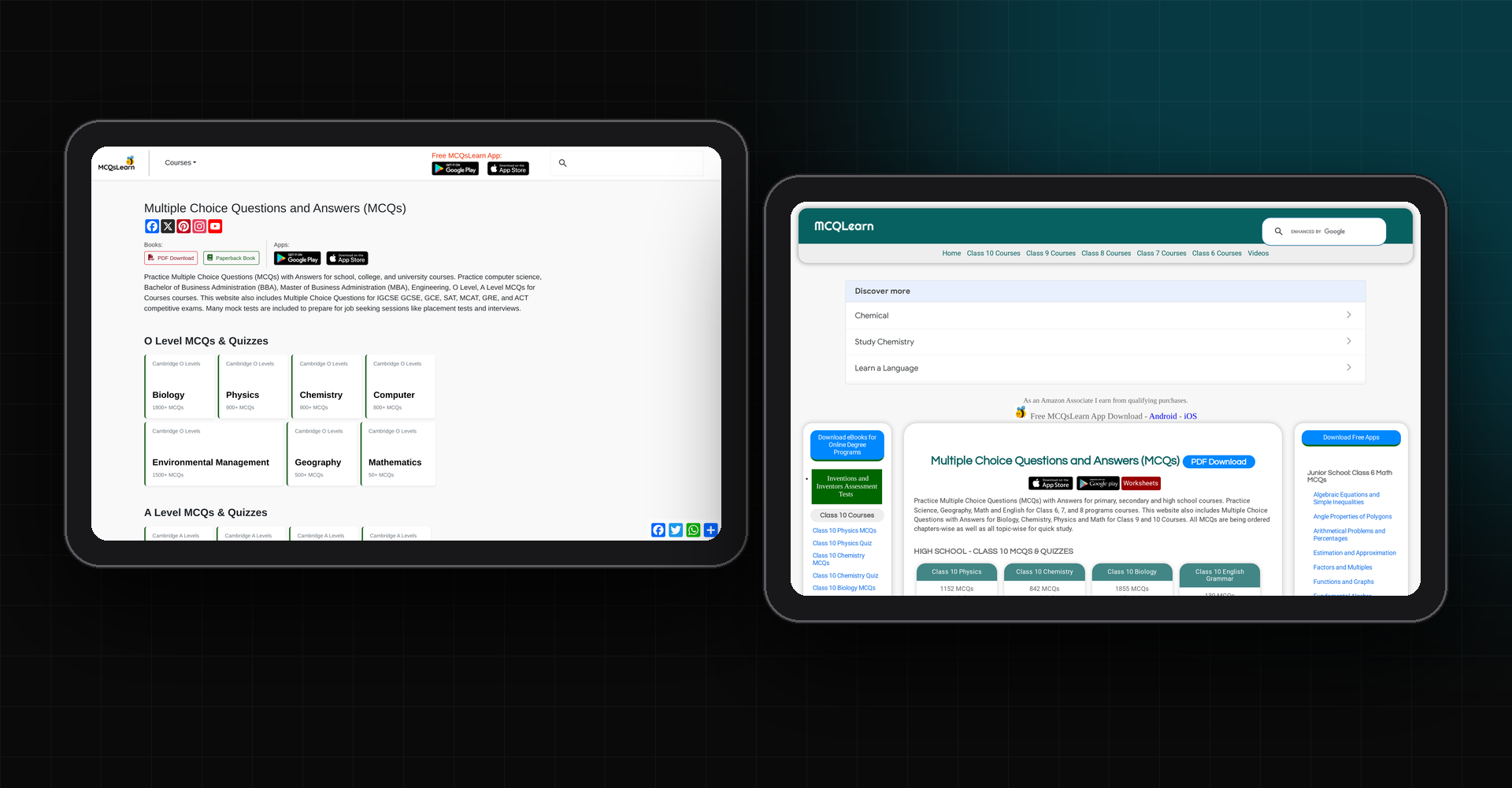
MCQsLearn.com (left) and MCQLearn.com (right) homepages shown side by side on tablets
Same engine, two audiences: MCQsLearn.com for secondary-to-professional learners, MCQLearn.com for Class 6 to 10.
Case study 02 MobileiOS + AndroidSubscriptionsGamification

MCQsLearn Mobile Apps

A portfolio of 54 single-subject apps on the App Store plus the MCQsLearn: All-in-One Courses flagship on both stores, with timed quizzes, streaks, badges, readiness scores, SAT mock tests, a guest mode and an in-app subscription economy.

  • RoleProduct, UX, iOS & Android engineering, store ops
  • PlatformsiOS 13+, Android
  • Flagshipv15.0, updated April 2026
  • LinksApp Store · Google Play
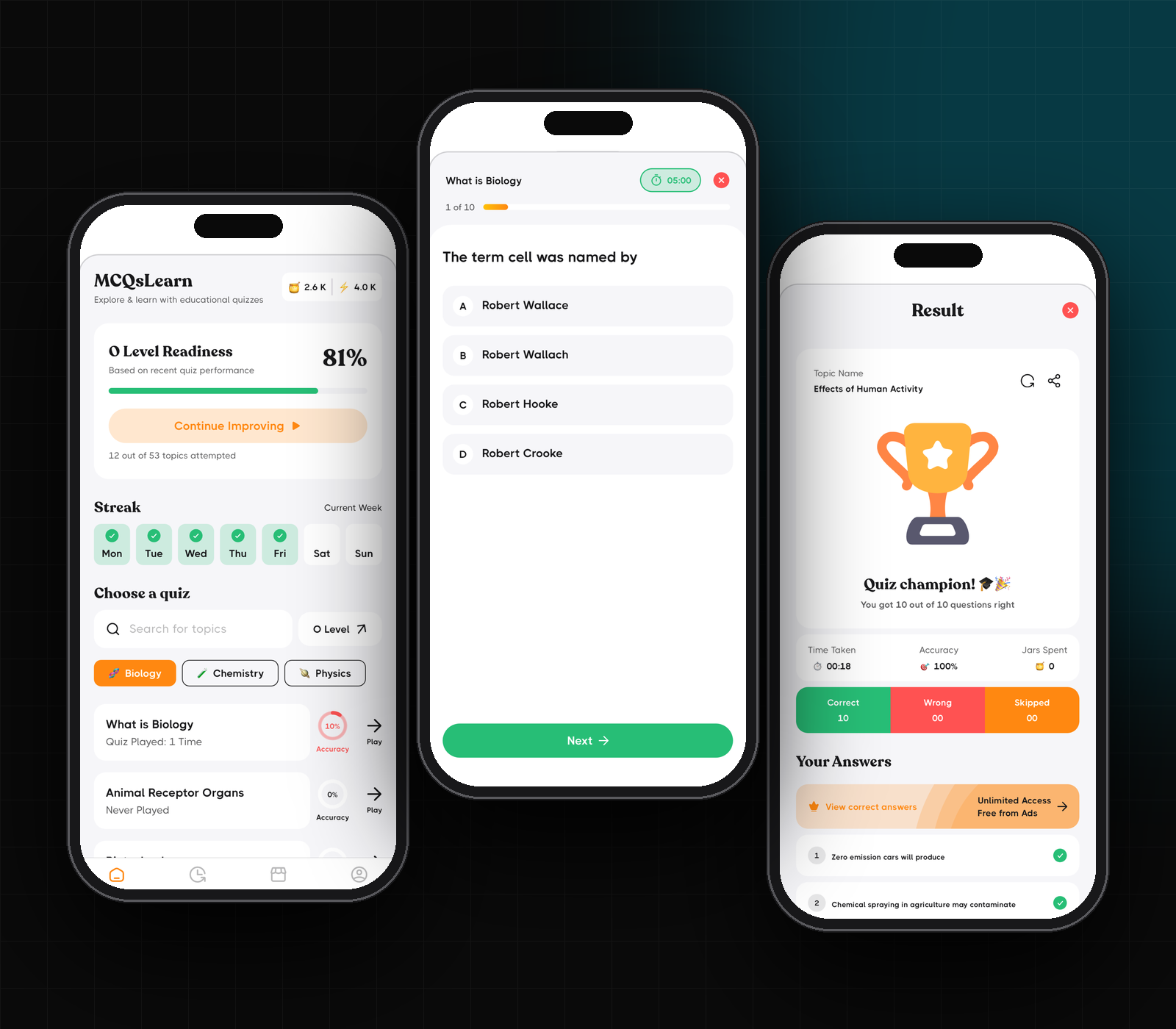
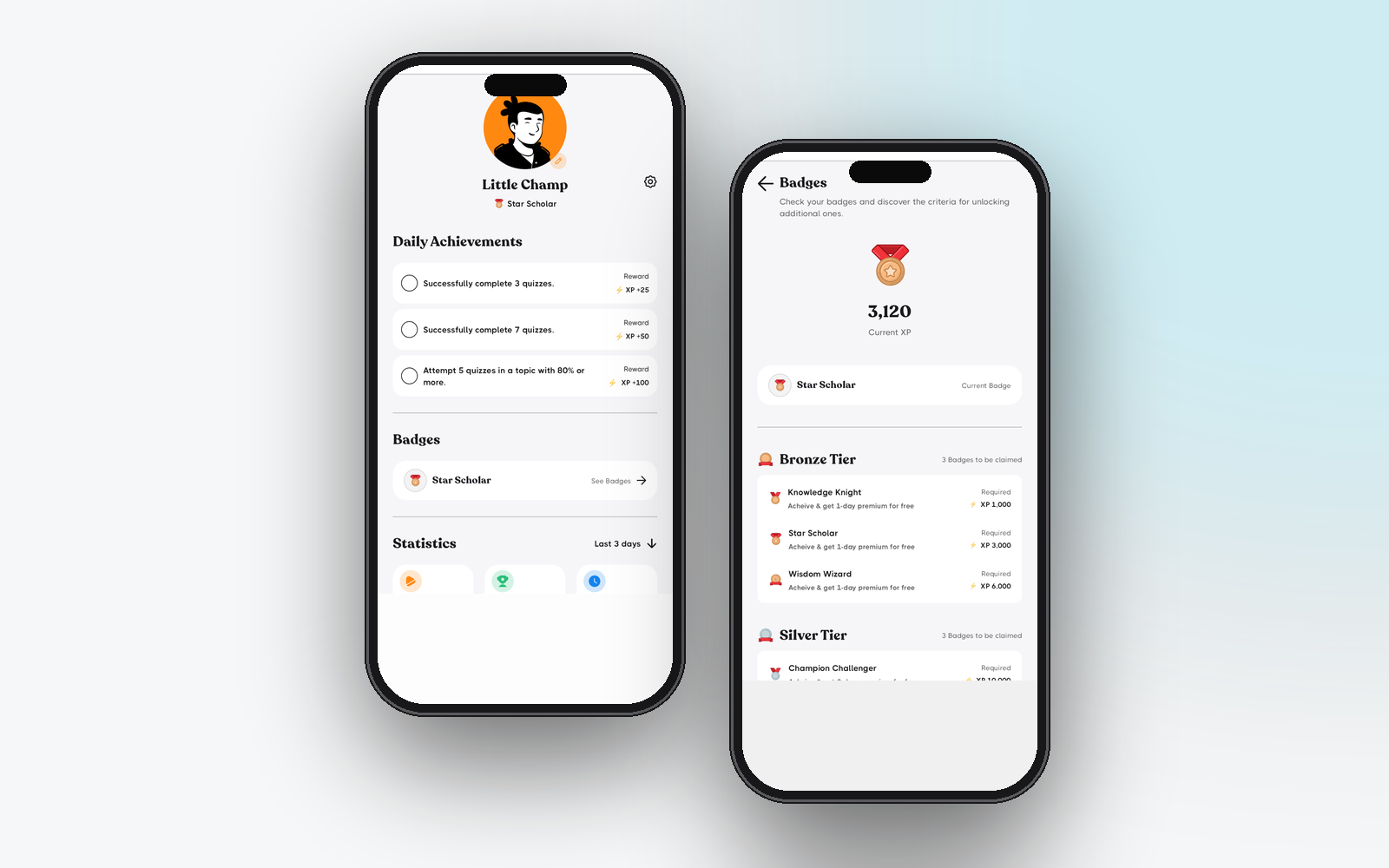
Three MCQsLearn All-in-One app screens: dashboard with O Level Readiness 81% and streak, a timed quiz question, and the Result screen
Dashboard with readiness score and streak · timed quiz · result screen with accuracy and per-question review. Official App Store screens.

The challenge

The websites proved demand, but students revise on phones, often offline, in short sessions. A mobile product had to do three things the web could not: keep learners coming back daily, let them practise without a connection, and convert a free audience into a sustainable subscription business without the experience feeling like a paywall.

We also needed a store strategy. Single-subject apps rank well for specific searches ("A Level Chemistry quiz"), but fragment the user base. The flagship had to unify everything under one roof while the subject apps kept driving discovery.

What we built

A two-tier app portfolio. 54 focused apps, Microbiology Quizzes, College Biology Quizzes, Computer Networks Quiz (BSCS), Human Resource Management MBA and more, share one code base and ship from one release pipeline. On top sits the All-in-One app with every course, launched December 2021 and now at version 15.

Learning loop designed for retention. A personal dashboard shows an exam-readiness percentage ("O Level Readiness 81%") computed from recent performance, a weekly streak tracker, and quick-start chips for the subjects a learner studies most. Quizzes can be timed; results break down correct, wrong and skipped answers with time taken and accuracy, and every answer can be reviewed.

Gamification that rewards consistency. XP accrues with each attempt; badges unlock across Bronze, Silver and Champion tiers; daily achievements and a leaderboard-style ranking give short-term goals. These mechanics were tuned over multiple releases to lift day-7 return rates.

Monetisation. A free tier with ads, in-app purchases, and a premium subscription that removes ads and unlocks unlimited access. A guest mode lets students try everything before creating an account, and SAT mock tests give premium a clear, high-value anchor.

Store operations. Automated builds, metadata and screenshot generation for 55 listings, plus compliance with both stores' education and privacy requirements (rated 4+ on iOS).

Outcome

  • 4.6★ · 10K+ App Store rating and Google Play installs for the All-in-One app
  • 55 live apps across two stores, all on a shared code base
  • 15 major versions shipped since 2021, still updated in 2026
  • 25,000+ MCQs available offline in the flagship
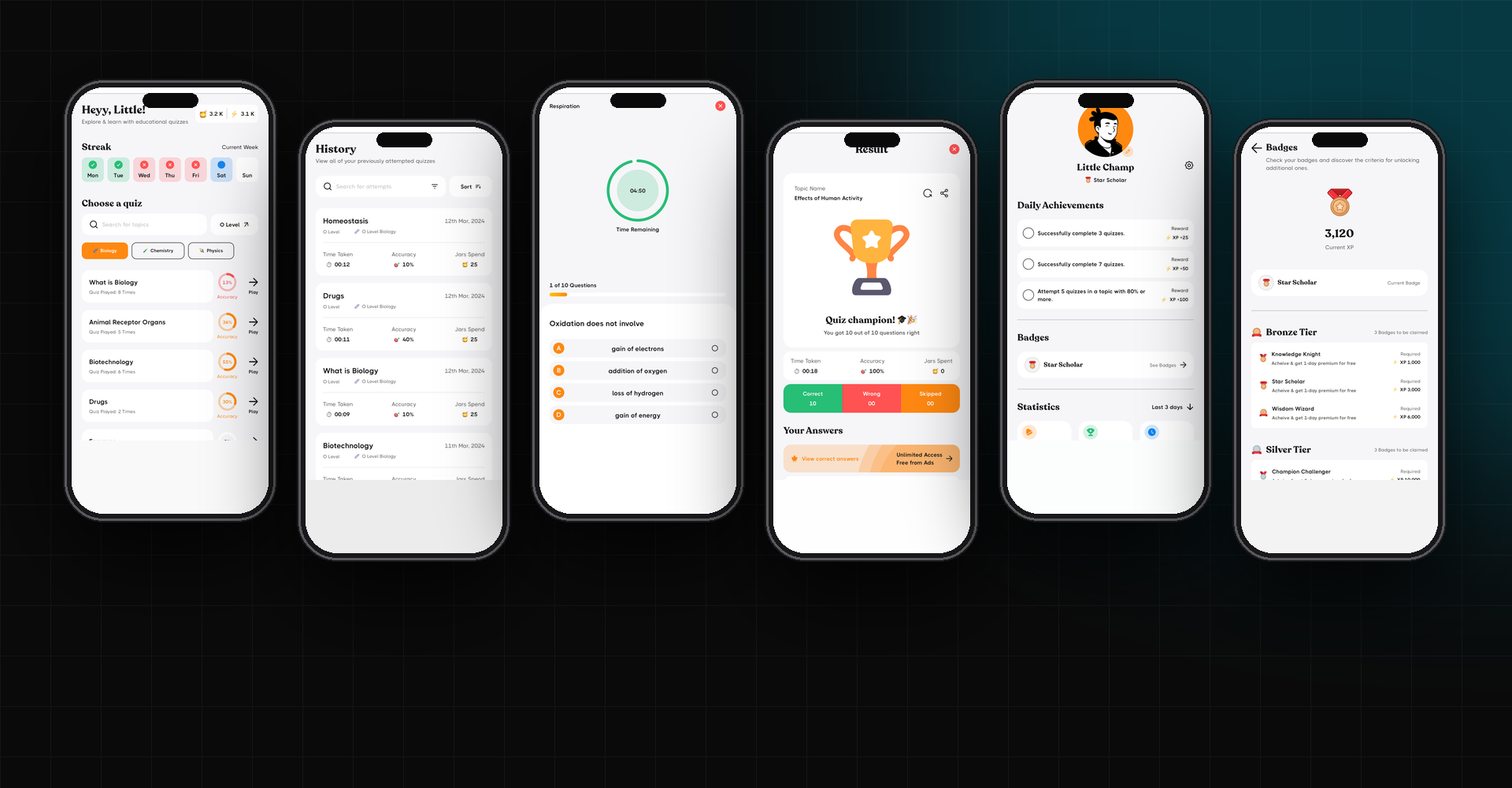
Six official Google Play screenshots of the MCQsLearn All-in-One app: dashboard, history, timed quiz, result, achievements and badges
The full Google Play screenshot set: dashboard, attempt history, timed quiz, result, achievements and badge tiers.
Case study 03 Digital PublishingContent PipelineAutomation

MCQsLearn E-Book Series

98 structured study guides on Apple Books (MCQ books, quiz books and short-notes editions) generated from the same question bank that powers the websites and apps, through a pipeline that turns a content update into a store-ready publication.

  • RoleContent pipeline, typesetting automation, cover system, store ops
  • ChannelsApple Books, Google Play Books, PDF, paperback
  • Catalogue98 titles, first wave June 2023
  • LinkApple Books author page
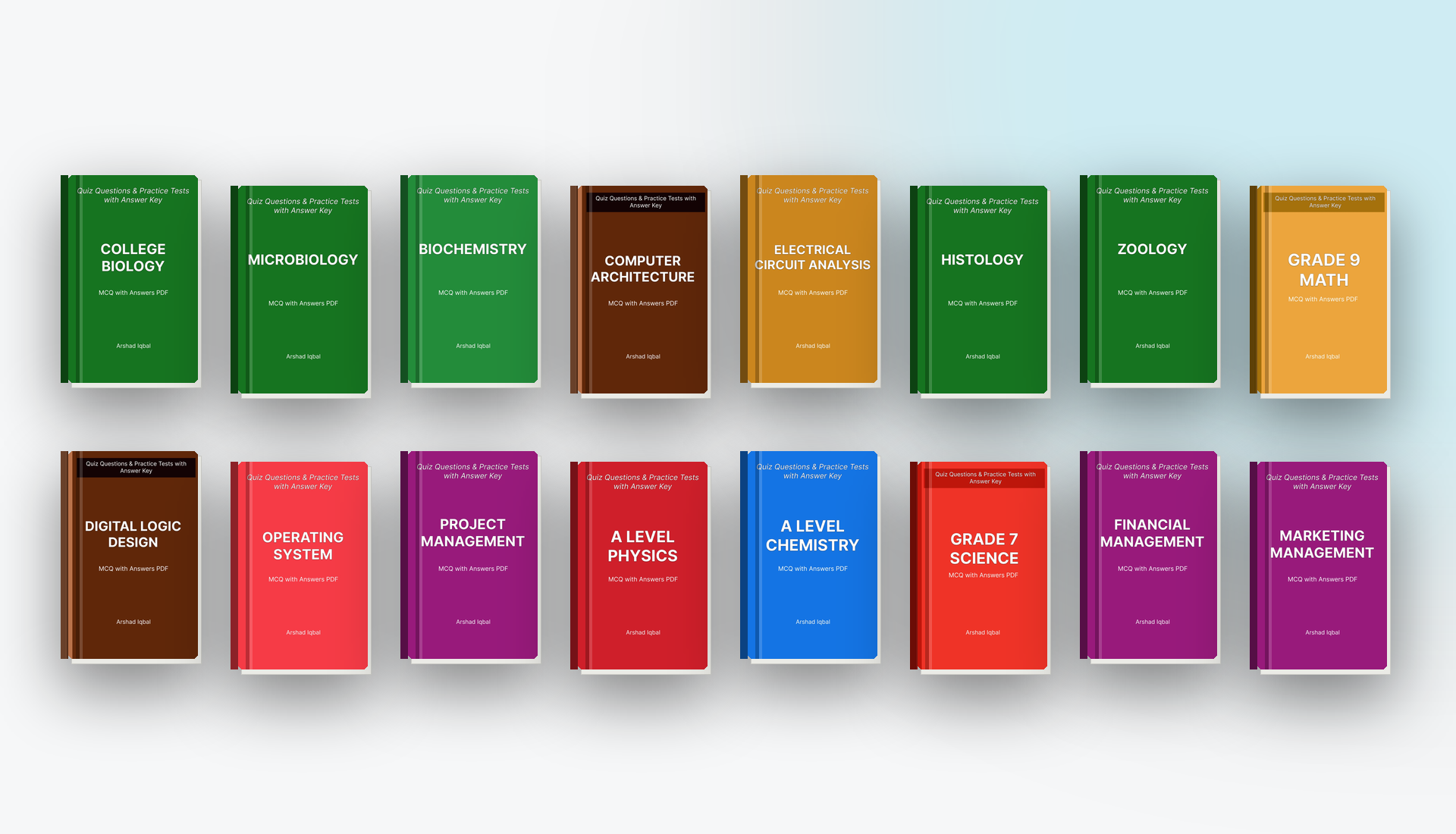
Sixteen MCQsLearn e-book covers including College Biology, Microbiology, Biochemistry, Computer Architecture, Electrical Circuit Analysis, Histology, Zoology, Grade 9 Math, Digital Logic Design, Operating System, Project Management, A Level Physics, A Level Chemistry, Grade 7 Science, Financial Management and Marketing Management
Sixteen of the 98 published titles. Colour encodes the subject family; the cover system is generated, not hand-designed per book.

The challenge

A large share of students still prefer to study from a book, on a tablet, as a PDF, or in print. But producing a hundred books by hand is impossible for a small team, and a hand-made book goes stale the moment the underlying content improves. The question was whether publishing could be treated as a build output rather than a separate project.

What we built

Content-to-book pipeline. Each title is defined by a course and a format (MCQs with answers, quiz questions with answer key, or short notes). The pipeline pulls the relevant questions, chapters and explanations from the shared bank, lays them out with consistent typography, generates the table of contents and index, and produces print-ready and store-ready files.

Generated cover system. Covers follow one template (series label, title, subtitle, author) with a colour family per subject area (green for biological sciences, brown for computer science, gold for engineering, purple for business, red and blue for school and Cambridge courses). Consistency makes the series instantly recognisable in store search results.

Multi-channel distribution. The same source renders to EPUB for Apple Books and Google Play Books, to PDF for direct download from the websites, and to paperback layouts. Every book links back to its course page and app, and every course page links to its book.

Catalogue operations. Metadata, descriptions, keywords and pricing are generated with the files, so a new title can be submitted within hours of the content being approved.

Outcome

  • 98 titles on Apple Books, with parallel distribution on Google Play Books and as PDFs
  • Three formats MCQ books, quiz books and short notes from one source of truth
  • Hours, not weeks from content approval to store submission
  • Biology to PHP school, Cambridge, university, business, engineering and programming titles
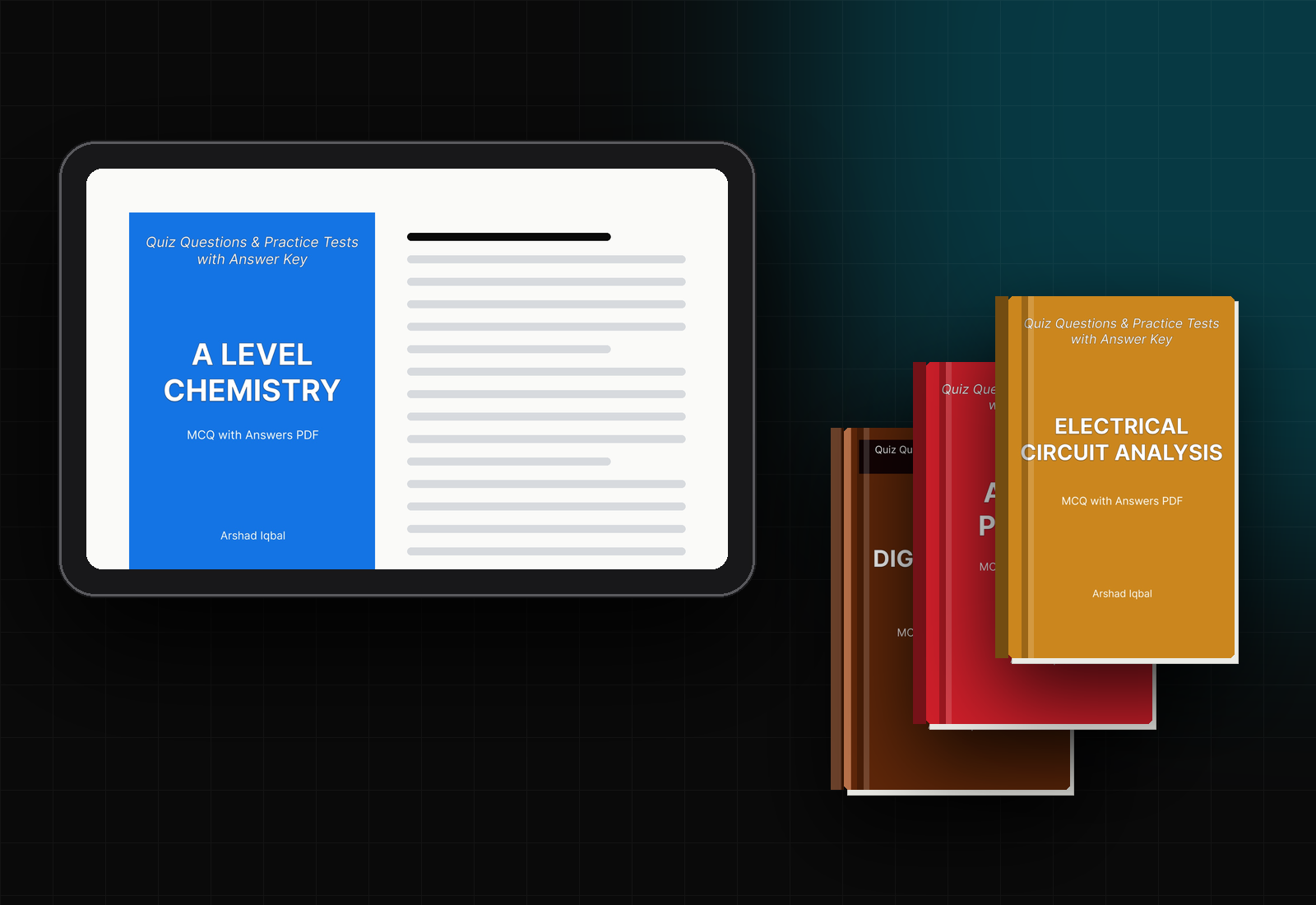
A Level Chemistry e-book open on a tablet beside printed copies of Digital Logic Design, A Level Physics and Electrical Circuit Analysis
One source, every format: tablet, PDF and paperback editions share the same content and cover system.

What this means for your project

We bring product-owner judgement to client work.

Architecture that scales content

We've run one content model across websites, 55 apps and 98 books. We design your data so growth doesn't mean rewrites.

Retention and revenue, not just launch

Streaks, readiness scores, subscriptions and store optimisation are things we've tuned on live products with real users.

Operations discipline

Release pipelines, store compliance, QA and monitoring that keep dozens of products live simultaneously.

Your project

Want results you can verify in an app store?

Tell us what you're building, whether a learning platform, a mobile app, a SaaS product or an AI feature, and we'll show you how we'd approach it.